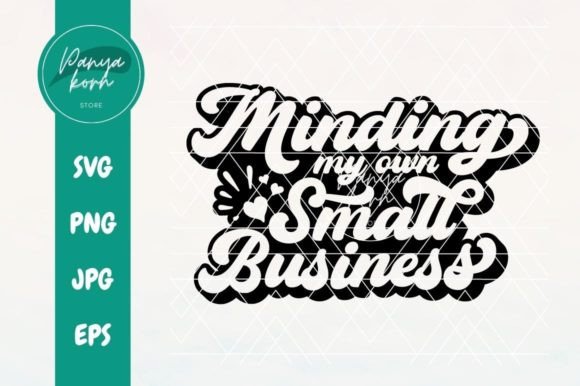
Minding My Own Small Business
A Designer’s First Look: Charm With Clear Intent
When I opened Minding My Own Small Business for the first time, I didn’t see just another “mom life” graphic—I saw a design with immediate personality and commercial intuition. The layout is clean, centered, and lightly playful, balancing bold lettering with subtle typographic rhythm. It reads quickly, lands warmly, and carries that rare blend of confidence and approachability that resonates with real small business owners—not caricatures. As a designer who’s stitched hundreds of custom pieces for Etsy sellers, boutique shops, and local makers, I knew right away this wasn’t a throwaway SVG—it was a potential anchor piece for a whole line of handmade product.
Real-World Test: Embroidering It on a Linen Tote Bag
Last week, I used Minding My Own Small Business to embroider a 10”x14” natural linen tote for a client launching her home-based candle studio. We chose a medium-weight cutaway stabilizer and matte cotton thread in deep charcoal. The result? Crisp, legible, and quietly professional—no bleeding, no puckering, no awkward gaps between letters. Because the design avoids fine serifs or ultra-thin strokes, it translated beautifully into satin and fill stitch without needing manual cleanup. That’s not guaranteed with every “funny mom” graphic—but Minding My Own Small Business was built with embroidery logic in mind, even though it’s marketed as a T-Shirt Design and Graphics file.
Where It Shines—and Where It Needs Thought
Minding My Own Small Business works especially well on structured, medium-to-heavy fabrics: sweatshirt embroidery, embroidered patch backings, aprons, pillow covers, and tea towels. Its generous letter spacing and moderate height (roughly 3–4 inches at standard scaling) give it breathing room on textured surfaces. I’ve also used it successfully on baby embroidery projects—think onesies or burp cloths—when scaled down to ~2.5”, but only with lightweight tear-away stabilizer and reduced stitch density to avoid stiffness.
That said, proceed with care on stretchy fabric like jersey knits or thin cotton tees. Without proper stabilization and hooping technique, the central phrase can distort slightly during stitching. It’s also not ideal for curved surfaces like caps unless resized and re-digitized for cap hoops—this version is flat-layout optimized. And while it looks great on dark fabric in light thread, avoid pairing it with overly busy prints or heavily brushed textures unless you test first: the clean lines need contrast to read clearly.
What Customers Actually Notice
Here’s what matters most when you’re selling finished products: people don’t buy fonts—they buy feeling. When someone sees Minding My Own Small Business stitched on a tote at a craft fair, they pause because it feels *true*. Not cutesy. Not ironic. Just grounded, relatable, and quietly proud. That authenticity lifts perceived value—especially for handmade product buyers who prioritize intention over trend. I’ve watched customers pick up items featuring this design twice as often as generic “Boss Mom” alternatives, and they almost always comment on how “real” it feels.
Practical Notes Every Embroidery Designer Should Keep Handy
- Always test first: Run Minding My Own Small Business on scrap fabric matching your final project’s weight and weave—even if it’s “just a tote.”
- Check thread color contrast: This design relies on legibility, not decoration. Avoid low-contrast combos like navy-on-navy or heather gray-on-gray unless you’re aiming for subtlety (and know your audience will get it).
- Review stitch density: If you’re using it for baby embroidery or lightweight apparel, reduce fill density by 10–15% to keep the fabric soft and breathable.
- Confirm hoop size compatibility: While the original file is vector-based (Illustrator, Photoshop, Silhouette-ready), your embroidery software may require digitizing. Make sure your chosen hoop comfortably fits the full phrase width before committing.
- Inspect small details: Though minimal, the slight curve under the “g” in “Business” and the open counters in “Own” hold up well—but zoom in before stitching to verify no stray nodes or overlapping paths.
- Test in black and white mockups: Before listing on Etsy or printing a printable mockup, check how Minding My Own Small Business reads in grayscale. If it loses clarity, adjust kerning or stroke weight digitally first.
- Verify licensing for commercial use: Since this is sold as a digital embroidery file for craft business and small shop product use, confirm whether resale of finished embroidered items is permitted—some SVG bundles restrict redistribution or mass production.
Beyond the Stitch: Branding, Trust, and Giftability
As a creative entrepreneur myself, I pay close attention to how designs affect buyer trust. Minding My Own Small Business doesn’t scream “sale”—it invites conversation. That makes it ideal for personalized gift embroidery, holiday embroidery (think cozy sweatshirts for Mother’s Day or small business owner birthdays), and boutique branding where tone matters more than volume. It also pairs seamlessly with minimalist logos or hand-drawn icons—no visual competition, just quiet cohesion.
For Etsy sellers and digital product sellers, this design holds strong as both a standalone machine embroidery design and a flexible base for layered applique design or monogrammed variations. Its versatility across categories—custom apparel, embroidered patch, kitchen towel design, nursery decor—means one purchase supports multiple product lines without diluting brand consistency.
The Bottom Line for Makers Who Ship Real Work
Minding My Own Small Business isn’t flashy—but it’s reliable, expressive, and thoughtfully composed for real-world execution. It respects the craft: no excessive detail that gums up your needle, no fragile elements that vanish in fill stitch, no assumptions about your fabric or skill level. Whether you're prepping a batch of sweatshirt embroidery for your small shop, creating a personalized gift for a fellow entrepreneur, or building design assets for your next digital product launch, this is one of those rare graphics that earns its place in your working library—not just your inspiration folder.